🎓 Research Takeaway • By Carla Moreno (11th Grade, St. Michael’s High School)
A famous headline claimed that ‘men connect front-to-back while women connect side-to-side.’ But when scientists re-checked the computer code, they discovered the secret: it was just the physics of skull size!
•
🔬 Primary Source: Dr. Jürgen Hänggi et al. (University of Zurich & Frontiers)
•
🔗 DOI: 10.3389/fnhum.2014.00547
The Analogy Corner
The City Bridge vs. Side Street Analogy
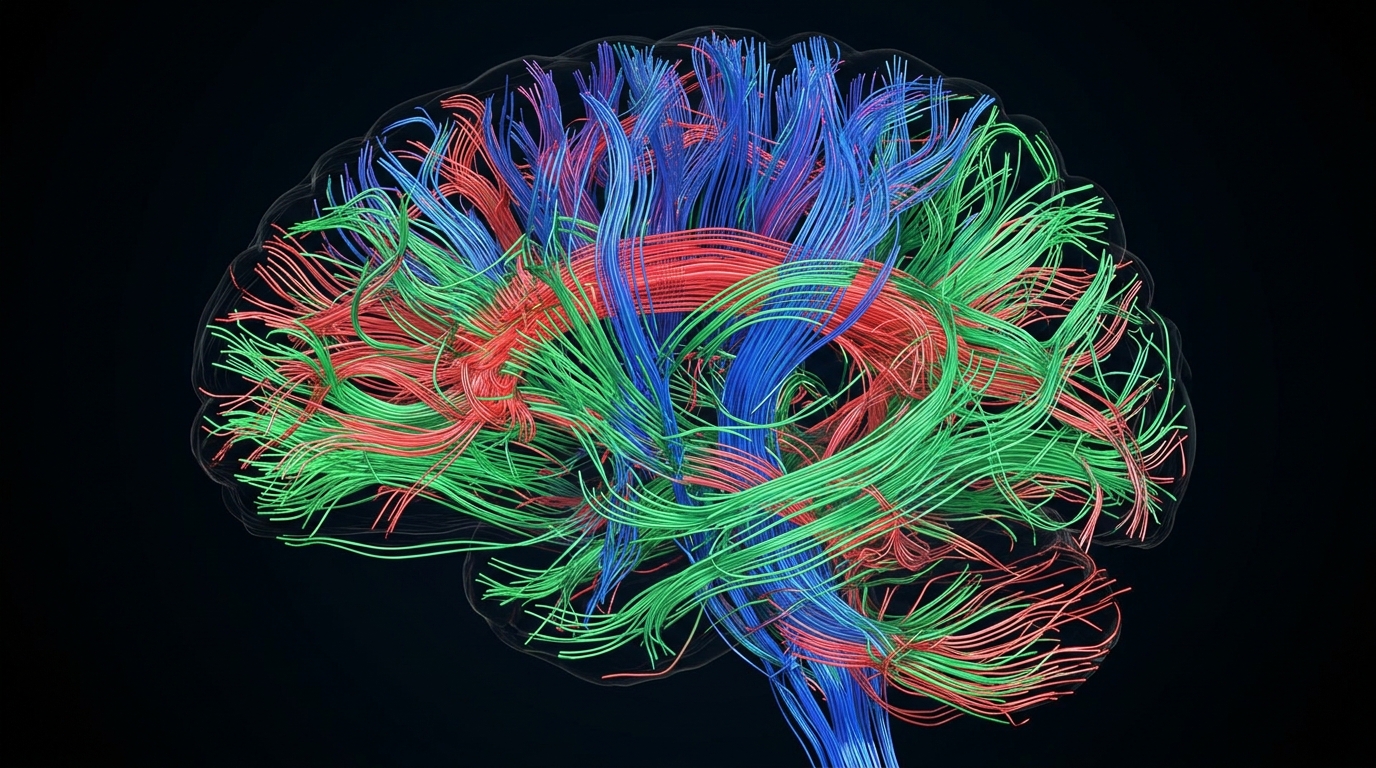
Imagine two cities: Mega City (wide and spread out) and Compact Town (dense and close together). In Compact Town, it’s quick and easy to drive across the bridge to the other side. In Mega City, driving across town takes forever, so you mostly take local side streets inside your own neighborhood. Does that mean the cars are fundamentally different? No! The roads simply follow the physical geography of the town. That’s exactly how brain wiring algorithms track fibers in different skull sizes!
🚀 The Big Question
Do boys and girls have completely different wiring diagrams inside their brains, or did computer tracking algorithms get tricked by head size?
🔬 What the Scientists Actually Did
In 2014, a study made world headlines claiming men have more connections within each hemisphere (local streets) while women have more connections between the two hemispheres (cross-bridges). But neuroscientist Dr. Jürgen Hänggi and his colleagues re-analyzed the data using physics and geometry corrections.
📊 What the Brain Scans Revealed
-
The Geometry Effect: In larger skulls, nerve fibers have to travel longer physical distances. Diffusion tractography software has a harder time tracing long curved fibers across the brain, so it records more short local tracks. -
When Head Size Is Equal, Wiring Is Equal: When men and women with the same head size were compared, the differences in brain connectivity disappeared! -
Everyone Uses Both Networks: Every human uses both local circuits (for specialized tasks like seeing and moving) and cross-hemisphere highways (for combining sights, sounds, and thoughts) every millisecond.
🛑 Brain Myth Buster
Myth: Women are natural multitaskers because of ‘cross-brain wiring’.
Fact: Multitasking is a skill anyone can practice or improve. Studies show that when distracted, both men and women experience the exact same drop in performance!
Myth: Men can only focus on one thing at a time because of ‘one-side wiring’.
Fact: Complex tasks like playing soccer, driving, or solving math problems require both hemispheres to communicate instantly in all humans.
Try This in Class or at Home!
The Multitasking Test: Try writing a sentence about your favorite video game while simultaneously saying the alphabet backwards out loud. Notice how your brain has to rapidly switch back and forth? That’s your prefrontal cortex working, regardless of gender!
📖 Brain Words in Plain English
- Connectome
- A complete 3D map of all the neural pathways and wiring connections in the human brain.
- Diffusion Tensor Imaging (DTI)
- A special MRI technique that maps brain wiring by tracking the microscopic motion of water molecules along nerve fibers.
- Corpus Callosum
- The thick bundle of over 200 million nerve fibers connecting the left and right halves of your brain.
📚 Original Peer-Reviewed Publication
Citation: Dr. Jürgen Hänggi et al. (University of Zurich & Frontiers)
Persistent Identifier: https://doi.org/10.3389/fnhum.2014.00547
Curated By: Carla Moreno, 11th Grade Student, St. Michael’s High School, Niagara Falls, Canada
Open Science License: CC BY 4.0 (Educational Attribution)
Leave a Reply